

How to Prepare a Shy Preschooler for Group Activities

Last Updated: November 2, 2026
Quick Summary
To prepare a shy preschooler for group activities, visit the room a week ahead when it is quiet, rehearse the routine at home in four or five steps, and arrive early on the day. Stay close during the first ten minutes, then step back to a chair and finally the doorway.
Ask the leader for a short visit when the room is quiet, and leave while it is going well.
Rehearse the entry routine at home in four or five steps using the teacher's words.
Leave ten minutes earlier than you think you need to on the morning of the activity.
Fade your presence in three steps: stand beside your child, move to a chair, then the doorway.
Keep playdates to around one hour with one friend and a simple activity ready.
Table of Contents
Understanding Your Slow to Warm Up Child Before Group Activities
A shy preschooler is not a child with a problem to fix.
The term slow to warm up describes a child who watches before joining. These children feel the room out first. They scan faces. They check who is safe.
That pause is not rudeness. Understanding how children develop during the preschool years can help you read your child's shy signals with more confidence.
What Slow to Warm Up Actually Means for a Preschooler
Slow to warm up is a temperament style, not a diagnosis. It means a child needs a longer runway before feeling comfortable in a new social setting.
Most of these children do fine once settled. The trouble comes at the front end: the entry, the greeting, the circle time.
Reading Your Child's Comfort Level and Signals
Watch for the small signs. They tell you more than words do.
Clinging to your leg or jacket
Going quiet when other children arrive
Standing at the edge of the play area
These signals are not defiance. They are requests for more warm-up time.
Slow to Warm Up Child Strategies That Lower the Pressure
The best slow to warm up child strategies share one rule: shrink the ask. A shy child does not need a big push. They need a smaller step.
Try these moves:
Arrive early. A quiet room beats a crowded one.
Name what will happen next. "First we hang up your bag, then we say hello to Miss Ana."
Let your child watch first. Standing back is participation.
Skip the forced hello. A wave from the doorway counts.
Stay close, then step back. Move a little farther each visit.
Gentle encouragement beats cheerleading. "You can do it!" can feel like pressure to a child who is already unsure.
A Practical Preparation Plan for Preschool Group Activities
Most advice on shy preschoolers stays abstract: build confidence, go slowly, don't push. What caregivers actually need is a plan they can run in the days before a group activity and the morning of. Here is the sequence we would use with our own families, with the specific words and actions for each step.
Seven Days Out: One Short Visit and One Familiar Face
Call the preschool or activity leader and ask whether a short visit is possible when the room is quiet. The goal is not to play. The goal is to make one adult and one room familiar.
Walk in, look around, and let your child set the pace.
Introduce one teacher by name and let your child hear you use it: "This is Miss Ana. She will be here when you play."
Point out two or three landmarks: the cubby, the bathroom, the snack table.
If an in-person visit is not possible, ask for photos of the classroom, the playground, and the teachers. You can also look through pictures of the classrooms and playground together to help your child picture the space ahead of time.
Three Days Out: Rehearse the Routine at Home
The routine is the script your child will follow. Walk through it out loud, in order, using the same words the teacher will use.
"First we walk in. We hang up your bag on your hook."
"Then we say hi to Miss Ana. A wave is fine."
"Then you choose a table or a rug to play on."
Keep it to four or five steps. If your child is verbal, have them repeat the steps back. If not, act them out with toys: a stuffed animal hangs up a tiny bag, waves to another stuffed animal, and sits down to play.
The Day Before: Lower the Stakes and Protect Sleep
A tired child is a clingy child. Keep the day before calm and protect the normal bedtime. Avoid scheduling a big event, a long car trip, or a crowded outing the day before a first group activity.
Pack the bag together. Let your child choose one small comfort item if the program allows it, and confirm with the teacher in advance whether a comfort object can come in.
The Morning Of: Normal Routine, Early Arrival
Eat a normal breakfast. Do not skip it to arrive early.
Leave ten minutes earlier than you think you need to. A rushed morning makes a shy child cling harder.
Arrive among the first few children, not the last. A quiet room beats a crowded one.
The First Ten Minutes: Stay Close, Then Step Back
Use a simple three-step fade:
Stand next to your child for the first few minutes.
Move to a chair at the edge of the room.
Move to the doorway, then leave.
Tell your child what you are doing at each step: "I am going to sit on that chair while you play." Predictable movement is easier to tolerate than a sudden disappearance.
Watch out: if your child is still clinging hard after two weeks of the same drop-off, that is a signal to talk with the teacher about a slower entry, not to push harder.
Here is the preparation sequence laid out step by step, from a week before to the first ten minutes.
When | What to do | Key detail |
Seven days out | One short visit and one familiar face | Visit when the room is quiet; leave while it is going well |
Seven days out (no visit) | Ask for photos of classroom, playground, teachers | Look at them together two or three times |
Three days out | Rehearse the routine at home | Keep it to four or five steps |
The day before | Lower the stakes and protect sleep | Keep the day calm and protect normal bedtime |
The day before | Pack the bag together | Confirm with the teacher whether a comfort item can come in |
The morning of | Normal routine, early arrival | Leave ten minutes earlier than you think you need to |
The first ten minutes | Stay close, then step back | Stand next to child, move to a chair, then the doorway |
What to Tell Your Child and How to Rehearse Together
The words you use matter. Keep them short, warm, and specific.
Try a simple script:
"You might feel shy at first. That is okay. You can watch until you feel ready. I will always come back." REGISTER →
Then rehearse. Practice the entry at home. Walk to the door, say hello to a stuffed animal, and shake hands with a toy. It sounds silly, and it works.
A common mistake is over-reassuring. Ten minutes of "you'll be fine" can signal that something is wrong. One calm sentence lands better.
Role-Play Activities for Preschoolers That Build Social Confidence
Role-play lets a child try a social moment before it counts. If you want the full case for this approach, our guide on the importance of play-based learning in early childhood explains why it works so well.

Here are role-play activities for preschoolers to try at home:
Pretend playdate. Line up stuffed animals. Practice saying hello and asking to play.
Ordering at a pretend cafe. Your child "orders" from you. This builds speaking practice.
Show and tell. Your child shows a toy and says one sentence about it.
Feelings charades. Act out shy, happy, and scared faces. Naming feelings lowers fear.
Keep sessions short. Five minutes of play beats a forced half hour.
Activities to Build Confidence in Shy Children at Home and in Small Groups
The best activities to build confidence in shy children share one trait: they are low-pressure. There is no spotlight and no audience.
Try these:
Parallel play with one peer. Two children play side by side with their own toys.
Small-group art. Two or three children color at one table.
Helper jobs. Give your child a task, like handing out napkins.
For a deeper list, our article on preschool activities that build social skills covers options you can set up at home or in a small group.
How to Help a Shy Child Make Friends Through Playdates and Parallel Play
If you want to know how to help a shy child make friends, start with one friend. Not a party. One child, one hour, one home.
Begin with parallel play. Two toddlers with their own blocks, near each other, is a real social step.
Set up the playdate for success:
Keep it short, around one hour
Pick a calm time of day
Have a simple activity ready
Watch out: a long, crowded playdate can backfire. Start small and build up over several visits.
Coordinating with Preschool Teachers and Activity Leaders
A five-minute conversation before the first session can change how a shy child's entry goes. Before that conversation, it helps to have a checklist of key questions to ask a preschool director. The teacher can offer a gentle welcome, explain the routine, and avoid putting your child on the spot. Many programs welcome this information; keeping it short and specific helps.
What to Tell the Teacher Before Day One
Send a short note or ask for a brief call. Cover four things:
What calms your child. "She settles fastest if you crouch down and speak quietly."
What signals overwhelm. "He goes silent and holds his own hands when the room gets loud."
How long warm-up usually takes. "She typically watches for five to ten minutes before joining."
What not to do. "Please don't single her out for a hello in front of the group."
Ask two questions in return: What does the first ten minutes look like? And where can a child go if the room feels like too much?
A Simple Script for the Handoff
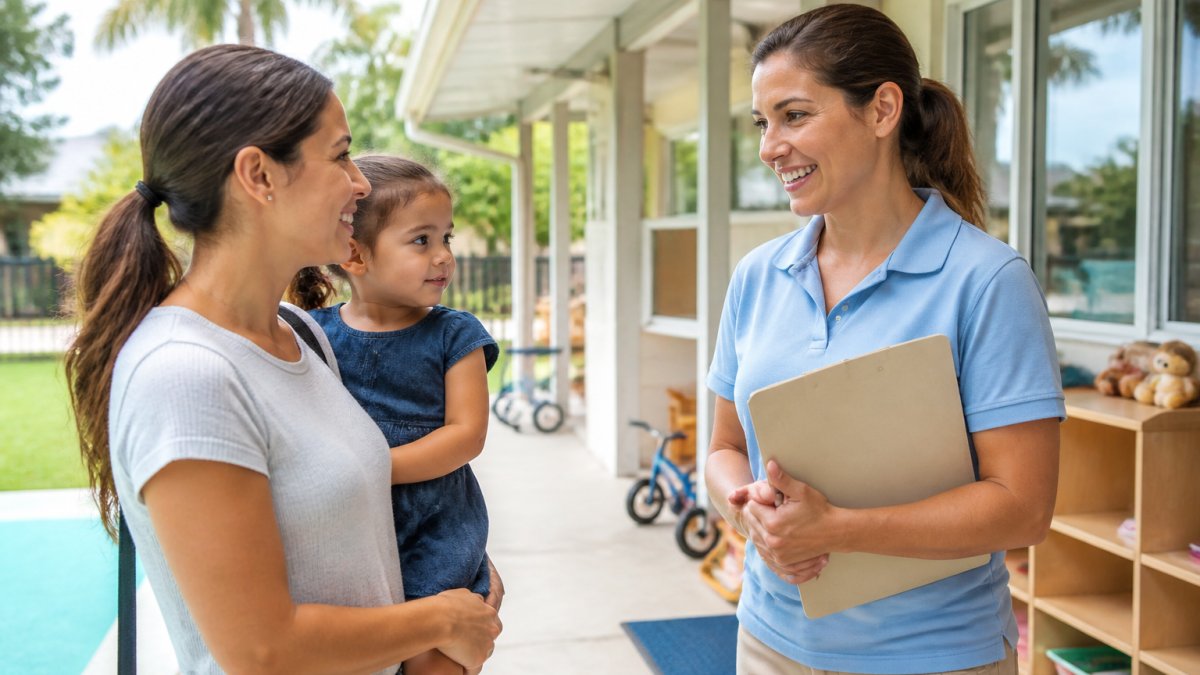
At the door, hand off with the same words every time: "Miss Ana, this is Maya. She is going to watch for a bit and then play. I will be back after snack." The teacher takes over the greeting, and your child hears the plan one more time from a familiar adult.
Inclusion: Noise, Language, and Accessibility
Shyness often overlaps with sensory or communication needs, and the same accommodations help both.
Noise. Ask whether the room has a quiet corner and whether the teacher can give a heads-up before loud activities like music or clean-up.
Transitions. Ask how the teacher signals a change: a song, a countdown, a visual schedule. A child who knows the signal is less likely to freeze.
Language. If your child is learning English or the program uses a second language, ask how the teacher supports children who are still building vocabulary. A picture card or a buddy can carry a lot of the load.
When the First Session Goes Badly
A hard first session is common and is not a verdict.
Ask three questions: Did she settle after I left? What helped? What should we change next time? Then adjust one variable, not five: a shorter session, an earlier arrival, or a different activity.
Watch out: if your child is distressed at every drop-off for more than a few weeks, or if the distress is affecting sleep and eating, raise it with your pediatrician.
Frequently Asked Questions
How can I help my shy preschooler join group activities without pushing too hard?
Start with a short warm-up time where your child watches from your lap or a nearby chair. Narrate what you see: 'That looks like a fun block tower.' Then offer one low-pressure role, like handing out napkins or holding the book. If your child declines, say 'We can try again next time' and stay nearby. Repeated, predictable exposure with familiar adults and familiar peers builds comfort faster than forcing participation. Praise any small step, even sitting near the group without joining.
What role-play activities for preschoolers can we practice at home before a group setting?
Try simple scripts: practice saying 'Can I play?' with a stuffed animal, rehearse asking a teacher for help, or act out joining a pretend circle time with dolls. Keep sessions to five or ten minutes and follow your child's lead. You can also swap roles so your child plays the teacher and you play the shy child. These rehearsals make the real moment feel familiar, which reduces the surprise that often freezes a slow to warm up child.
Should I encourage my shy preschooler to participate or let them watch?
Both, in sequence. Watching is a valid first step, not a failure. Let your child observe for a few minutes while you stay close, then offer one manageable interaction, like giving a high-five to a familiar peer or placing a toy in the group pile. If they watch only, that still counts as progress. Over several sessions, increase the invitation slightly. The goal is gradual introduction, not immediate participation, so your child learns that the group is safe.
When should I be concerned about my preschooler's shyness?
Shyness alone is not a concern. Look for signs that go beyond slow to warm up: extreme distress that does not ease after 20 to 30 minutes, refusal to speak in most settings for months, physical symptoms like stomachaches before every group event, or withdrawal from familiar adults and peers. If these persist across home, preschool, and playdates, talk with your pediatrician or a child development specialist. Early support helps, and many children simply need more warm-up time and gentle encouragement.
Every shy child needs a patient start, and finding the right setting makes all the difference. Kids Zone Academy offers a safe, caring environment with small-group routines, hands-on activities, and Spanish instruction that help children build confidence and social skills over time. Get started with Kids Zone Academy and give your child a warm, steady path into group learning.

Comments