

Which Preschool Activities Build Social Skills?

Last Updated: October 29, 2026
Quick Summary
Preschool social development grows through structured, repeated practice with peers under gentle adult guidance. Dramatic play, short social-emotional learning routines, and group projects like circle time and shared art all give children chances to share, take turns, and name their feelings. Adults can adapt these activities so every child can take part.
Dramatic play like restaurant or doctor's office builds negotiation and role coordination.
Rotate roles on a set schedule so every child gets a turn in each part.
Model sharing, use a visible timer for turns, and praise specific actions.
Use a monthly checklist to track progress from "not yet" to "consistently.
Adapt activities by changing one thing at a time, such as seating, materials, or group size.
Table of Contents
Most parents assume social skills develop on their own once children are around other kids. The research on early childhood suggests it is more deliberate than that. Structured activities for preschool social development give young children the practice they need to share, take turns, and work through disagreements. The right activities do more than fill the day. They build the habits that carry into kindergarten and beyond.
Why Preschool Social Development Matters Now
Social development in early childhood is the foundation for later academic and emotional success. Children who learn to cooperate, communicate, and manage their feelings tend to adjust more easily to kindergarten.
The most useful activities share a common feature: they give children repeated, low-stakes chances to interact with peers under gentle adult guidance. Each interaction is a small rehearsal for the larger social world.
Play-Based Learning Benefits for Social Growth
Play-based learning is the practice of building lessons around child-led exploration with adult guidance.
Play-based learning benefits social growth in several specific ways:
Children practice negotiation when deciding who gets which role
They learn to read facial expressions and body language from peers
They build persistence when a shared plan does not work the first time
A common mistake is assuming play is unstructured. Effective teachers plan the environment, the materials, and the prompts, then step back so children can lead.
For a deeper look at how this works across development, read our guide to The Importance of Play-Based Learning in Early Childhood.
Role-Playing and Dramatic Play Activities
Dramatic play is one of the most effective ways to build social skills in preschool. When children pretend to run a restaurant, a doctor's office, or a family home, they must coordinate roles, follow shared rules, and respond to each other in real time.
Try these simple setups in your classroom or at home:
Restaurant: Assign a cook, a server, and customers. Rotate roles each week.
Doctor's office: Provide props like bandages and clipboards. Children practice empathy by "treating" a stuffed animal.
Grocery store: Children take turns as shopper and cashier, practicing polite requests and thank-yous.
Watch out: if one child always takes the lead role, the others may disengage. Rotate roles on a set schedule so every child gets a turn in each part.
Social-Emotional Learning Activities for Preschoolers
Social-emotional learning, often shortened to SEL, teaches children to recognize feelings, manage impulses, and show care for others. Preschool is an ideal time to begin, because children at this age are forming their first ideas about how emotions work.
Effective SEL activities for preschoolers include:
Feelings charts: Children point to faces that match how they feel during the day.
Emotion-matching games: Adults model a feeling, and children name it and suggest a response.
Calm-down routines: Teach a simple breathing exercise children can use on their own.
These activities support emotional regulation, a skill many children develop gradually over the preschool years. Teachers who name feelings out loud help children build emotional literacy.
Home vs. Classroom: Same Skill, Different Setup
Most guides blur home and classroom SEL, but the two settings call for different pacing. In a classroom, SEL usually runs in short whole-group moments (a morning greeting, a feelings check-in before centers) plus coaching during play. At home, SEL works best in one-on-one routines: naming feelings during bath time, practicing a calm-down breath before bed, or narrating your own frustration out loud ("I'm frustrated the lid won't open, so I'm going to take a breath and try again").
A practical split:
Setting | Best format | Typical length | Adult role |
Classroom | Whole-group circle, then coaching during centers | 5-10 minutes plus in-the-moment coaching | Lead the group, then step back |
Home | One-on-one during daily routines | 1-3 minutes, many times a day | Model and narrate |
Pro Tip Pick one SEL skill per week (for example, "asking for a turn") and practice it in both settings. Repetition across home and school is what makes the skill stick.
A Simple Progress Check
None of the top-ranking guides give parents or teachers a way to tell whether SEL activities are working. Use this informal checklist once a month. Mark each item "not yet," "sometimes," or "consistently."
Names a feeling without being prompted
Uses a calm-down strategy when upset (with a reminder)
Waits for a turn in a small group
A child who moves from "not yet" to "sometimes" on two or three items in a month is making normal progress. If most items stay at "not yet" for several months, that is a good reason to talk with your pediatrician or a preschool teacher about next steps.
For a deeper look at how play supports these skills, read our guide to The Importance of Play-Based Learning in Early Childhood.
How to Teach Sharing to Preschoolers
Sharing is among the most common challenges parents and teachers face. Young children often see shared materials as their own until they learn otherwise. Teaching sharing works best when it is modeled, practiced, and praised consistently.
Follow these steps:
Model the behavior. Narrate your own sharing: "I'm going to give you the blue crayon now."
Use a timer for turns. A visible sand timer helps children understand that their turn will come.
Praise specific actions. Say "You handed Maya the scissors. That was kind," not just "Good job."
Practice with real materials. Sharing a toy during play is more meaningful than a lecture.
Here is a quick summary of how to approach sharing at different stages:
Stage | Typical Behavior | Adult Response |
Early (ages 2-3) | Grabs and holds items | Model, redirect, narrate |
Middle (ages 3-4) | Takes turns with reminders | Use timers, praise turns |
Later (ages 4-5) | Shares with minimal prompts | Discuss fairness, encourage problem-solving |
Group Projects, Circle Time and Arts and Crafts
Group activities give children a structured setting to practice cooperation. Circle time, shared art projects, and small group building tasks all require children to listen, wait, and contribute.
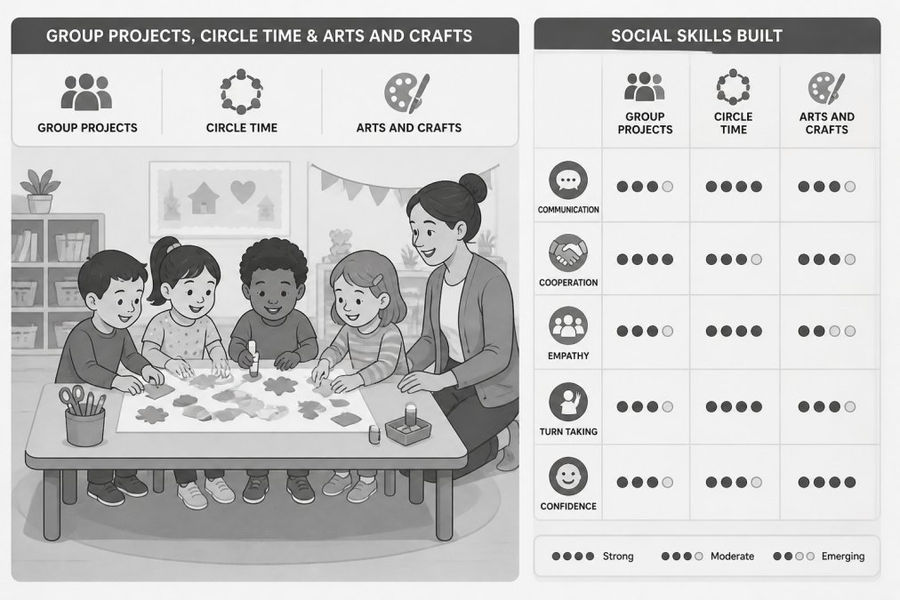
Circle time works well when it includes call-and-response songs, short stories with pauses for predictions, and simple turn-taking games.
!Preschool children working together on a shared paper craft at a low table with a teacher nearby
Our classrooms are arranged to support this kind of group work. You can see the spaces for each age group on our Classrooms for ages 2, 3, 4 and 5 page.
Adapting Activities for Neurodivergent Children
Not every child responds to group activities in the same way. Some children, including those with sensory sensitivities or autism, may find loud circle time or crowded craft tables overwhelming. Adapting activities can help every child take part. Most generic preschool guides stop at "offer a quiet corner." The adaptations below are tied to the specific activities in this article, so you can apply them without redesigning your whole day.
Adapt the Activity, Not the Goal
The social goal stays the same (taking turns, naming feelings, joining a group). What changes is the path. A useful rule: change one thing at a time (the environment, the materials, the group size, or the communication mode) and watch what happens before changing another.
Dramatic play (restaurant, doctor's office, grocery store):
Post a picture schedule of the roles so the child knows the order of turns.
Offer a script card with two or three lines ("Hi, what would you like?") for children who want words ready-made.
Let a child play the same role for several sessions before rotating; predictable roles lower anxiety.
Circle time:
Seat the child at the edge of the circle or on a defined spot (a cushion or tape square) rather than in the middle.
Offer alternative participation: point to an answer, hold up a picture card, or give a thumbs-up instead of speaking.
Keep circle time short (5-10 minutes) and signal transitions with a song or visual timer.
Reduce background noise by turning off music during directions.
Group art and shared projects:
Provide a smaller table or a separate tray with the same materials so the child works alongside peers without crowding.
Choose softer materials (felt, washable markers, low-odor glue) when sensory load is a concern.
Give a clear "done" signal, such as a finished-sample photo, so the child knows when the task ends.
Sharing and turn-taking games:
Use a visual timer the child can see and touch, not just a verbal countdown.
Practice turn-taking first with an adult in a quiet space, then add one peer, then a small group.
Praise the specific behavior ("You waited for the timer") rather than general praise.
Home vs. Classroom
At home, you control the sensory environment, so start there: dim lights, lower noise, and offer a calm-down space the child chooses. In a classroom, ask the teacher which adaptations are already in place and whether the same visual schedule or timer can be used at home. Consistency between the two settings matters more than the specific tool.
Watch Out Avoid removing a child from group activities as a default solution. A quiet corner is a tool for regulation, not a permanent exclusion. The goal is to bring the child back into the group once they are calm.
Tracking Progress
Use the same three-level checklist from the SEL section ("not yet," "sometimes," "consistently") and add two inclusive items:
Joins a group activity with a visual or verbal prompt
Uses a calm-down strategy in the classroom or home setting
Adaptations are not about lowering expectations. They are about giving each child a realistic path to the same social goals, and a way to see whether that path is working.
Booking a Tour at Kids Zone Academy in Saint Petersburg
Seeing these activities in action makes a difference when choosing a preschool. Our philosophy is simple: every child learns best when they feel safe, loved, and encouraged. Learning through play, caring guidance, and daily hands-on activities are part of how children build social and emotional skills, alongside Spanish instruction.
If you are weighing your options, Our Philosophy explains how we approach learning in more detail. Families who want to plan a visit can find our address and location on the map. For current pricing, visit our website or contact us directly for a quote, since pricing depends on the program and schedule.
Frequently Asked Questions
What are examples of social development activities for preschoolers?
Useful examples include dramatic play such as running a pretend store or doctor's office, turn-taking games like rolling a ball back and forth, group art projects where children share materials, and circle time storytelling where children take turns speaking. Each activity gives children a reason to negotiate, wait and cooperate. Start with short sessions of 10 to 15 minutes and add complexity as your child gets comfortable with taking turns and reading others' cues.
How do you teach social skills to a 3-year-old?
Model the behavior you want, name feelings out loud, and give simple scripts such as 'Can I have a turn when you're finished?' Practice in short, structured play sessions and praise specific actions, like sharing a block or waiting in line. Expect slow progress and repetition. Three-year-olds usually need many reminders before a skill becomes consistent, so keep expectations realistic and focus on one skill at a time.
Why is play-based learning important for social development?
Play gives children a low-pressure setting to practice negotiation, empathy and conflict resolution. When children build a block tower together or decide who plays which role, they must communicate and compromise. Adults can guide these moments with questions and modeling, which supports emotional regulation and cooperative play over time.
What are the key social-emotional milestones for preschoolers?
Preschoolers typically move from parallel play, where they play near but not with peers, toward cooperative play that involves shared goals and roles. Around ages 4 and 5, many children begin to take turns more reliably, recognize others' feelings and use words instead of physical reactions during conflicts. Milestones vary widely, so use them as general guideposts rather than strict benchmarks, and talk with your pediatrician if you have concerns.

Comments